Contents
When does a home need HEMS?How HEMS coordinates equipmentHow benefits reach the householdWho pays for the service?Why integration costs can be hard to recover
When does a home need HEMS?
A household’s reason to buy HEMS depends on the practical problem it can solve. Residents already have appliance controls, timers and charging schedules. An additional management system needs to improve everyday operation beyond that starting point to give them a reason to pay.[2][3]
Competing power demands provide one example. Suppose other appliances use 2 kW, a heat pump uses 2 kW and a vehicle requests 4 kW. With solar generation and battery operation excluded from this illustrative example, their combined 8 kW exceeds a household grid-import target of 6 kW. A controller could initially reduce charging to 2 kW, then restore it to 4 kW when the heat pump stops. The equipment shares the available power, although the vehicle still needs enough time to receive its required energy. Where adjustment of the charger alone solves the problem, a dedicated load-management function may be sufficient.
Equipment can also compete for the same solar surplus. Midday generation could charge a battery, charge a vehicle or run a heat pump. Each task has its own requirements: when the car leaves, when hot water is needed, or how much storage space remains. HEMS brings those tasks into a shared plan and allocates the available energy and operating times.[2]
Some households can shift substantial consumption towards lower-price periods and reduce imports when prices are higher. The return depends on how much energy can move, the price difference and equipment capabilities. The value of consuming solar electricity at home also depends on import prices, export payments and storage losses. These differences determine how much the same coordination function can achieve in different homes.[2][3]
How HEMS coordinates equipment
HEMS first gathers connection-point readings, device states and household requirements, then schedules operation through equipment interfaces. It monitors the results and adjusts the plan as conditions change. For example, the EEBUS self-consumption approach builds a shared schedule from solar forecasts, base demand and equipment constraints. The foresee research system at NLR, formerly NREL, uses forecasting and rolling optimization to schedule household equipment.[2][3]
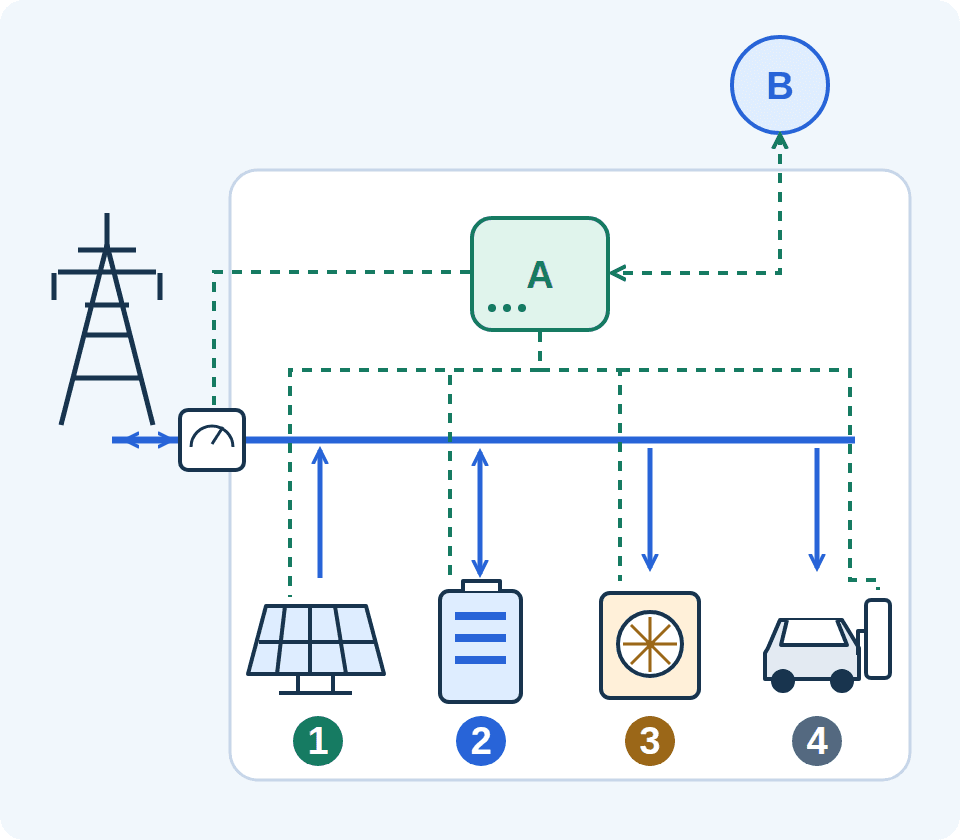
A · Coordination within the home
Collects connection-point readings and device states, then sends operating instructions. The controller coordinates equipment; electricity flows along the blue power path.
B · External signals or services
Provides prices, consumption limits or flexibility-service signals through the applicable interfaces and arrangements. The home controller turns them into device actions while accounting for equipment and household requirements.
1 · Solar PV
Produces electricity as sunlight changes, affecting how much the home needs to import or can export.
2 · Home battery
Charges and discharges within power, state-of-charge and reserve limits, changing when energy is used.
3 · Heat pump
Adjusts heating times where temperatures and operating conditions allow, while meeting space-heating or hot-water needs.
4 · EV charging
Adjusts charging times and power while the vehicle is connected, taking its departure-time energy requirement into account.
Author-drawn functional diagram based on [2][4]. The equipment combination is illustrative and varies by home. Dashed lines summarize monitoring and control; the implementation determines the communications used. The vehicle branch shows one-way charging.
Execution depends on complete information and control. The energy manager needs to know when the vehicle leaves, how much energy the battery can accept and how long temperature-controlled equipment can be adjusted. Equipment feedback informs the next scheduling decision. Operating limits and responses to communication faults are also part of this control process.[2][4]
Coordination functions can arrive with equipment or through an energy service provider. The delivery arrangement affects household costs. A separately purchased system brings installation and service charges; a function delivered through existing equipment or services depends on the package price and ongoing maintenance arrangements.[1][5]
How benefits reach the household
The same adjustment can produce different outcomes for different participants. Households want sufficient charging, comfortable temperatures and lower bills. Grid operators need to manage local peaks and network constraints. Energy service providers also consider load scheduling and customer relationships. The US DOE and partner institutions’ roadmap for grid-interactive efficient buildings identifies split incentives, consumer incentives and integration costs as implementation challenges.[5]
That raises a question of how benefits are shared. Suppose a household pays to connect its equipment and accepts changes to operating times, while its tariff and service contract offer little return for those changes. Much of the value of improved grid operation then stays with other participants. The household still pays for equipment, installation and service, sees little improvement in its bill and has a weak purchasing incentive.
Germany’s framework for controllable consumption devices under §14a links grid-oriented controllability with reduced network charges. The German regulator explains that the grid operator first settles network charges and reductions with the electricity supplier. The supply contract then determines how the reduction reaches the final customer. This settlement chain makes the contract an important link between system benefits and household returns.[7]
The framework offers direct device control and control through an energy management system. With EMS control, the household can distribute a shared power allowance between devices. Direct control acts on the relevant equipment. The equipment combination and the tasks involved determine the coordination needed.[8]
Who pays for the service?
For a household purchase, the case rests on concrete improvements. Bill savings, relief from power constraints and less day-to-day intervention need to justify the purchase and maintenance costs. An energy service provider also assesses business outcomes such as customer retention. The returns each party seeks influence how much it is willing to contribute.
The UK’s SENS program studied energy-saving products and services using smart-meter data. Its 2023 official evaluation recorded small-scale contracts with UK electricity retailers and service sales within a European pilot. In those cases, energy companies were the buyers of the services.[6]
Projects interviewed for the evaluation were also exploring a route in which electricity suppliers would offer services to households at low or no cost to help reduce customer churn. The supplier would fund service procurement and seek a return through customer relationships. The viability of this approach depends on business benefits covering procurement, integration and ongoing service costs.[6]
HEMS could follow a similar route as part of equipment delivery or an energy service. Residents would contribute through equipment prices, service fees or energy packages, while the provider would organize the technology and support. Coordination could enter the home through an existing purchasing relationship, with prices and service terms allocating the costs and benefits.
Why integration costs can be hard to recover
Technical delivery continues throughout a system’s life. Installation requires equipment interfaces, control permissions and on-site commissioning. Operation brings configuration, fault handling and maintenance. A larger equipment set extends the coordination scope and the integration and support work involved. The DOE roadmap and the UK’s Smart Secure Electricity Systems policy work both examine these issues.[5][9]
Existing controls may already have captured much of the improvement available to a household. Scheduled charging can use the main low-price periods, while appliance controls handle routine tasks. The remaining opportunity for coordination across devices may be small. The amount a provider can charge such a household is constrained by the practical improvement it can deliver, even as adaptation work adds costs.
Effects also need to be measured against the existing service. The SENS evaluation compared additional products with a basic smart-meter service. Some projects showed statistically significant additional energy savings, while others did not reach statistical significance. Trials of this kind help identify which functions provide an additional benefit and give providers a firmer basis for estimating the return they can deliver to households.[6]
Sales become difficult when most of the improvement benefits a grid operator or energy service provider, the household receives a smaller return and that household is expected to bear most of the integration cost. Residents see a high outlay, while providers struggle to recover their costs at an acceptable price. This is the commercial challenge for HEMS: find situations with a substantial need for coordination and arrange for the participants receiving the value to fund it.
References
- [1] Smart homes — Australian Government; HEMS section; no publication date shown; checked 21 October 2026
- [2] Self-Consumption Optimisation — EEBus Initiative e.V.; Shared schedules, equipment constraints and updates; no publication date shown; checked 21 October 2026
- [3] NLR's Home Energy Management System—foresee — National Laboratory of the Rockies (NLR, formerly NREL); Research project description; no publication date shown; checked 21 October 2026
- [4] Limitation of Power Consumption — EEBus Initiative e.V.; V1.0.0; PDF cover dated 14 October 2022; sections 2.2 and 2.6.2–3
- [5] A National Roadmap for Grid-Interactive Efficient Buildings — US DOE / LBNL and partners; Satchwell et al.; 17 May 2021; integration costs, incentives and split benefits/investment; US building-sector scope
- [6] Smart Energy Savings Competition (SENS): Overall impact evaluation report — UK Department for Energy Security and Net Zero; Ipsos et al.; June 2023; sections 4.2 and 5.2.2–3; specific smart-meter-based energy-saving products and services; low/no-cost offers were a business route being explored
- [7] Reduzierung des Netzentgelts — Bundesnetzagentur, Germany; Consumer guidance on network-charge reductions and supply contracts; no overall update date shown; checked 21 October 2026
- [8] Integration von steuerbaren Verbrauchseinrichtungen — Bundesnetzagentur, Germany; Consumer guidance on direct control and EMS control; no overall update date shown; checked 21 October 2026
- [9] Delivering a smart and secure electricity system: implementation — UK Department for Energy Security and Net Zero; Consultation published 16 April 2024; government response 23 April 2025; interfaces, permissions and service arrangements