ENERGY KNOWLEDGE
Energy knowledge base
Explore terms and concepts in energy management.
Dynamic Load Balancing
For site capacity management, dynamic load balancing (DLB) adjusts the total charging allowance and its allocation to individual chargers as other electrical loads and vehicle demand change. It allows charging to use the capacity available within an existing electrical limit.[1][2]
DLB →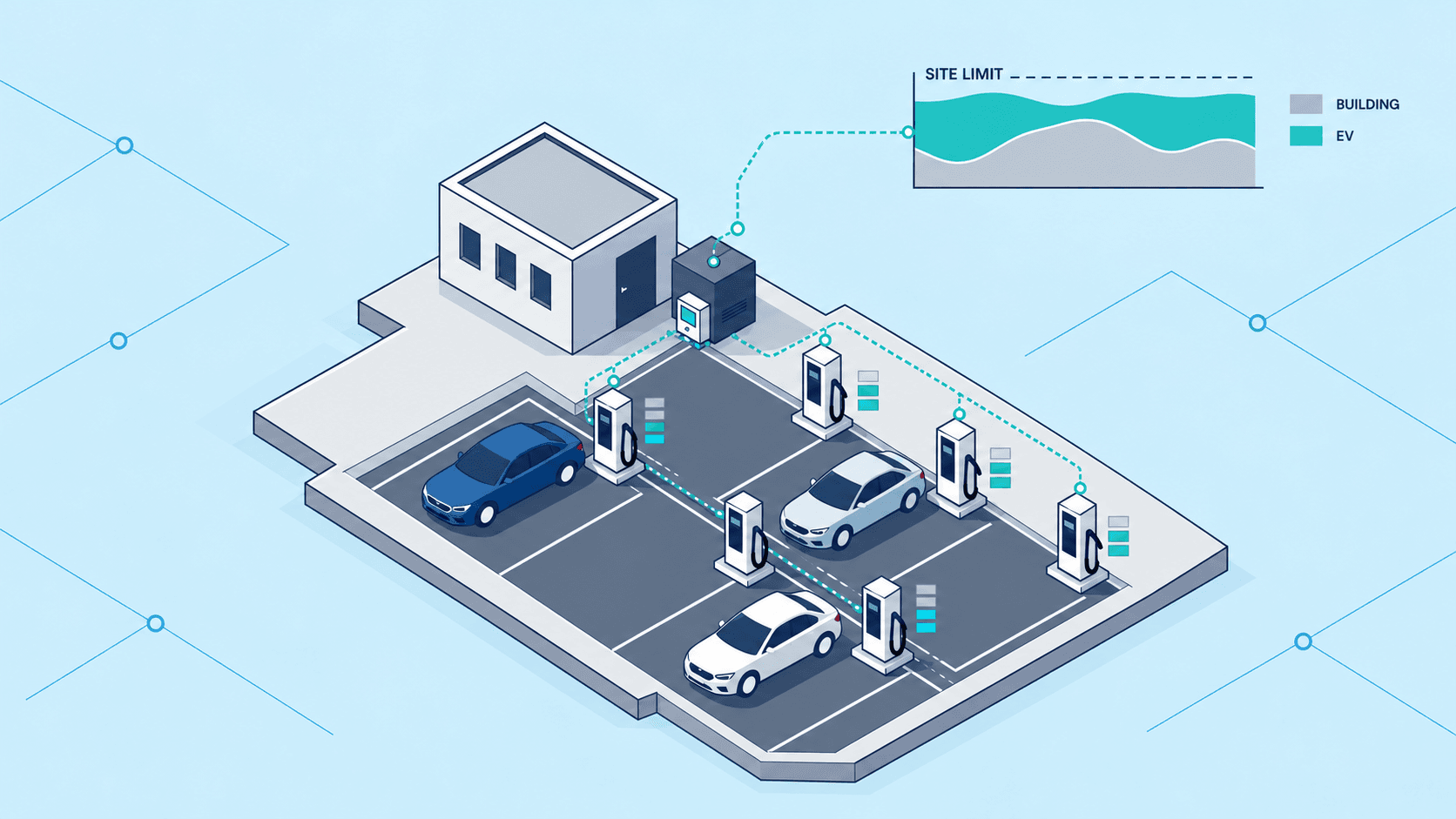
Find a term
Explore terms and concepts in energy management.
8 Knowledge
Modbus
Modbus is an application-layer communication protocol for exchanging data between devices. A client initiates a request and a server processes it and responds. Its services cover reading states and values and writing settings, over serial links or TCP/IP networks.[1]
OCPP
OCPP (Open Charge Point Protocol) is an open communication protocol between electric vehicle charging stations and a Charging Station Management System (CSMS). Maintained by the Open Charge Alliance (OCA), it defines how they exchange information for authorization, charging sessions, monitoring and remote operation.[1][6]
Peak Shaving
Peak shaving reduces the highest power a site needs from the grid over a period by scheduling consumption, adjusting equipment power or using local supply. It extends the focus from total energy consumed to when that energy is used and how much power is required at the same time.[1][2]
DLBDynamic Load Balancing
For site capacity management, dynamic load balancing (DLB) adjusts the total charging allowance and its allocation to individual chargers as other electrical loads and vehicle demand change. It allows charging to use the capacity available within an existing electrical limit.[1][2]
EMS
From manual monitoring to coordinated control: how energy management establishes operating rules, assigns responsibilities and develops broader scope and deeper decisions.
HEMS
HEMS stands for Home Energy Management System. It uses hardware and software to monitor and coordinate a home’s electricity generation, storage and consumption, helping connected equipment operate within shared supply conditions, power limits and household requirements.[1][2]
V2G
V2G stands for Vehicle-to-Grid: using bidirectional charging to return electricity from electric vehicles to the grid and help balance the power system.[1]
VPPVirtual Power Plant
A virtual power plant (VPP) uses communications and coordinated control to organize distributed generation, storage, and flexible loads into a group that can participate in power system operations and electricity markets.[1]