Contents
What OCPP connectsWhy a common protocol emergedHow charging needs shaped OCPPOCPP 1.6: coordinating charging within shared capacityOCPP 2.0.1: a clearer view inside the stationOCPP 2.1: charging as part of an energy systemHow certification supports interoperability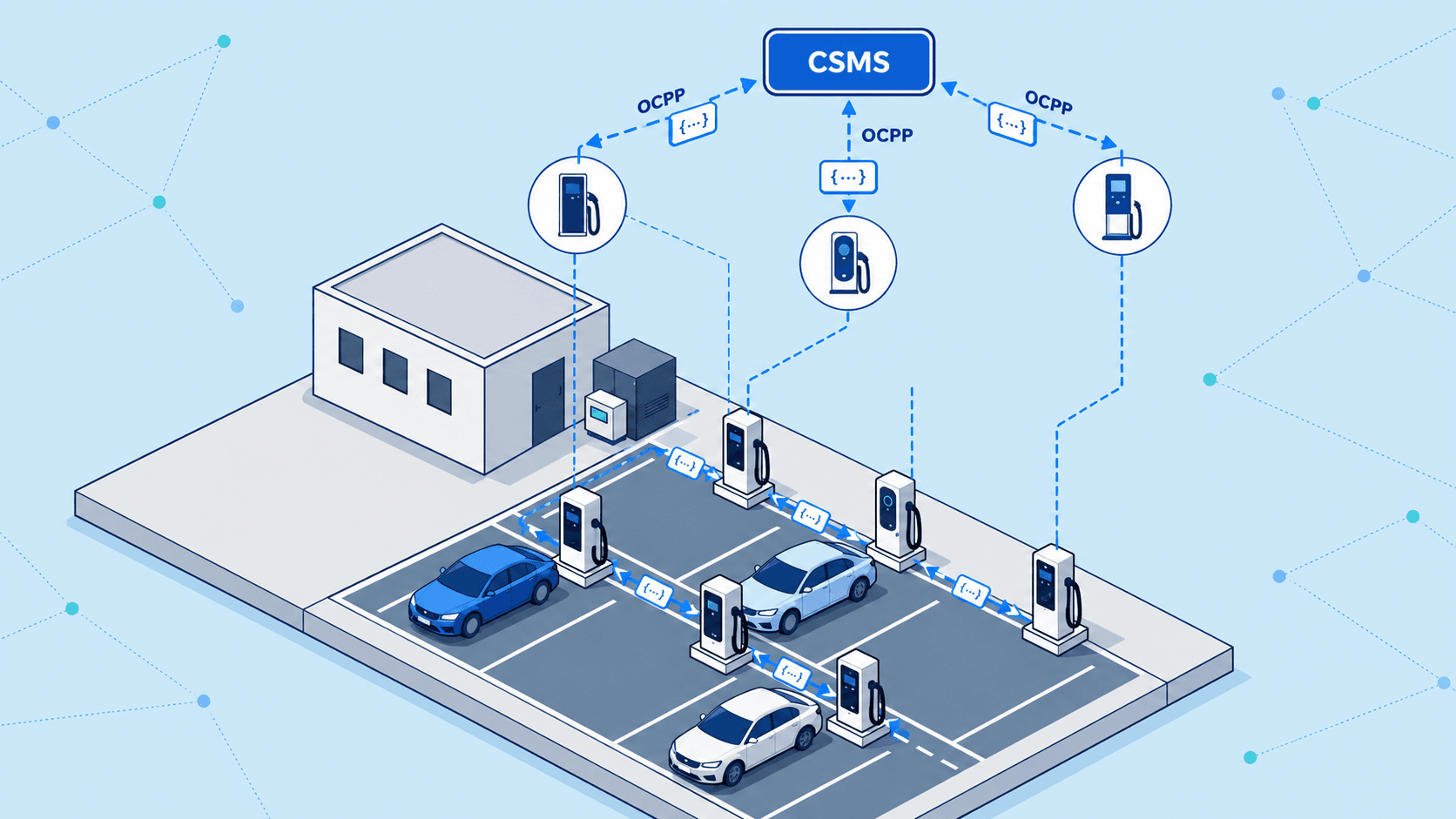
What OCPP connects
A charging network needs information to move in both directions. Stations report what is happening on site; the management system sends instructions back. OCPP supplies a common set of messages for this exchange, allowing equipment and software from different suppliers to work through an open interface.[6][7]
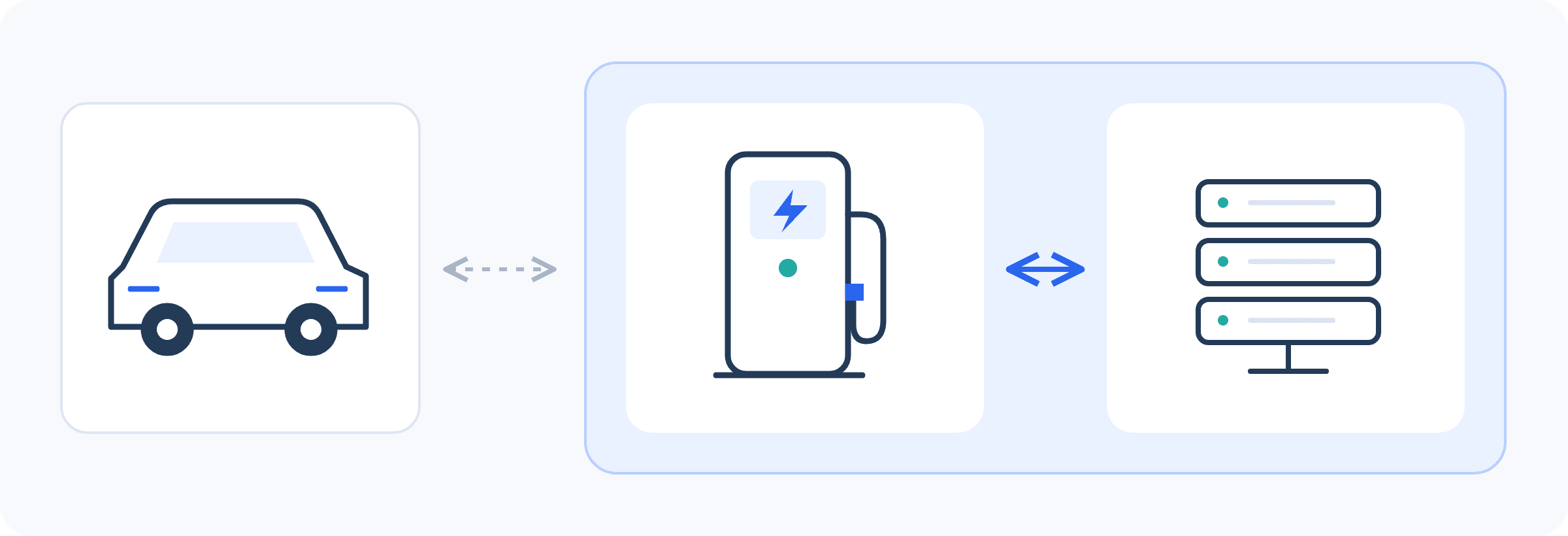
For a session using central authorization, the station submits a user identifier to the CSMS. It then reports the session and meter readings, providing a record of charging activity. The CSMS can also request remote actions, such as stopping a session, unlocking a connector or updating firmware.[6]
OCPP also carries availability information, faults and diagnostic logs. Together, these functions let an operator observe and manage a network without handling every action at the charger.[6]
OCPP 1.6 offers SOAP and JSON communication variants. In the JSON variant, messages travel over WebSocket; OCPP 2.0.1 also uses JSON over WebSocket. JSON describes the message data, while WebSocket provides the connection used to exchange it.[1][3][7]
Why a common protocol emerged
The original problem was connecting a network built from different suppliers’ chargers. In 2009, ElaadNL, a nonprofit founded by Dutch distribution system operators, wanted to procure equipment from multiple vendors. With no common information-exchange specification available, it began developing OCPP. Version 1.0 followed in 2010, and stewardship passed to OCA in 2014.[2]
An open interface reduces dependence on a supplier’s proprietary communication method. For a network that will grow and change over time, that creates a shared basis for integrating stations and management software.[7]
How charging needs shaped OCPP
Version changes are especially informative when read alongside the problems they address. OCPP 1.6, 2.0.1 and 2.1 illustrate an expanding management scope: coordinating charging demand, understanding equipment in greater detail, and supporting energy flows in both directions. These needs overlap; each stage below highlights a representative change.
OCPP 1.6: coordinating charging within shared capacity
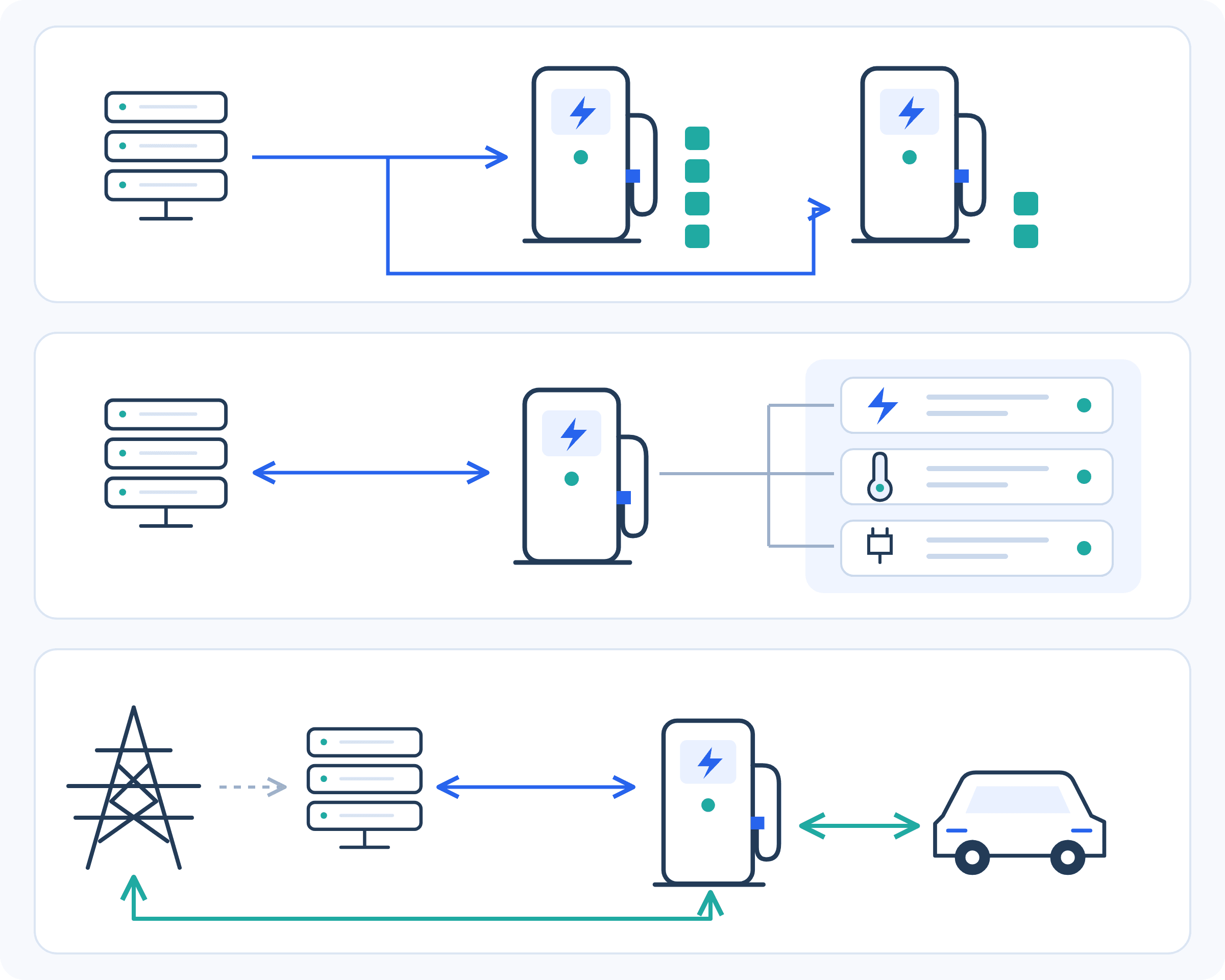
Consider a parking facility where several vehicles charge at once. Starting each session is only part of the task: the stations also share an electrical capacity limit. A management system can account for that limit when setting charging schedules, then send the instructions to the stations through OCPP.[7][8]
Smart charging support arrived with OCPP 1.6 in 2015. Charging profiles provide a way to communicate current or power limits over time, supporting load management and adjustments to when charging takes place.[1][7]
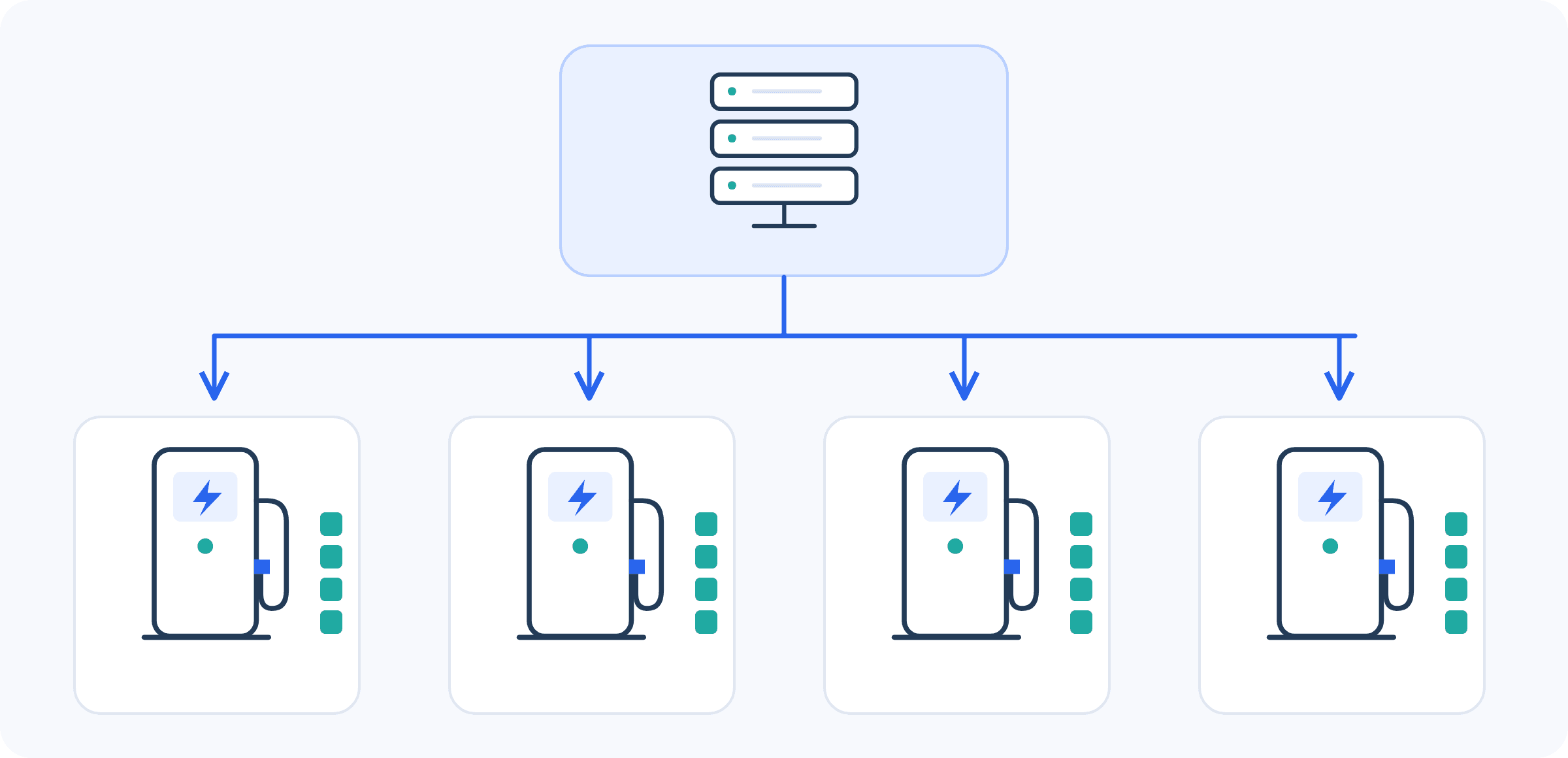
The distinction is useful: the management strategy decides how to allocate capacity, while OCPP communicates the resulting schedules and limits. In this example, the protocol gives a shared electrical constraint a form that several separate devices can act on. That is a practical step beyond managing each charger in isolation.
OCPP 2.0.1: a clearer view inside the station
More complex chargers brought a need for more detailed configuration and monitoring. Released in 2020, OCPP 2.0.1 introduced a device model that relates settings and observations to individual components. For example, an operator can configure a notification when a power-conversion component’s temperature crosses a threshold.[3]
Transactions also became more expressive. OCPP 2.0.1 allows configurable start and end conditions and brings transaction reporting into a unified TransactionEvent message. Cable connection, authorization and energy delivery need not mark the same moment.[3]
These changes help explain the move towards richer descriptions of both equipment and its use: an operator needs to locate a problem within a station and reconstruct how a charging session unfolded. This was a structural redesign; OCPP 2.0.1 is not backward compatible with 1.6.[3]
OCPP 2.1: charging as part of an energy system
When a vehicle can export power, managing charging also involves the opposite direction of energy flow. OCPP 2.1, released in 2025, adds bidirectional charging, ISO 15118-20 support and distributed energy resource (DER) control. It builds on 2.0.1 while preserving compatibility with its application logic.[1][2]
Seen together, these additions suggest a wider role for charging infrastructure. The vehicle can be considered a controllable energy resource as well as an electrical load, and management must coordinate charging and discharging. The progression is towards a richer relationship between vehicles, charging equipment and the surrounding energy system.
How certification supports interoperability
A shared specification defines the exchange; certification checks an implementation against the applicable requirements. OCA’s certification program uses independent testing laboratories to assess OCPP implementations.[2][4]
For OCPP 2.0.1, the Core profile is mandatory for certification. Advanced Security, Smart Charging and ISO 15118 Support are optional certification profiles. A certificate’s version and profile scope therefore describe which capabilities have been assessed.[4]
References
- [1] OCPP: Discover our open standards for future-ready EV charging — Open Charge Alliance; Protocol overview; publication date not stated
- [2] Discover our history — Open Charge Alliance; Historical overview covering milestones from 2009 to 2025; publication date not stated
- [3] What is new in OCPP 2.0.1 — Open Charge Alliance; Version 1.0, March 2023
- [4] Certification OCPP 2.0.1 — Open Charge Alliance; Current certification scope; publication date not stated
- [5] ISO 15118-20:2022 — Road vehicles — Vehicle to grid communication interface — Part 20 — International Organization for Standardization (ISO); Edition 1, April 2022; official public abstract only
- [6] OCPP for Resource-Constrained Devices — Open Charge Alliance; Version 1, March 2025; sections 1 and 3 on functions and messages
- [7] Importance of Open Charge Point Protocol for the Electric Vehicle Industry — Open Charge Alliance; Publication date not stated; cited for open interfaces, communication and smart charging, not historical version status
- [8] OCPP to Manage Charging Stations / Using OpenADR with OCPP — Open Charge Alliance; Publication date not stated; cited for charging flexibility and grid-load principles, not historical dates or statistics