
Contents
Where the idea beganWhy frequency regulation came firstFrom research to paid grid servicesWhy V2G matters more todayHow a V2G system worksWhere deployment stands todayThe market conditions for wider adoption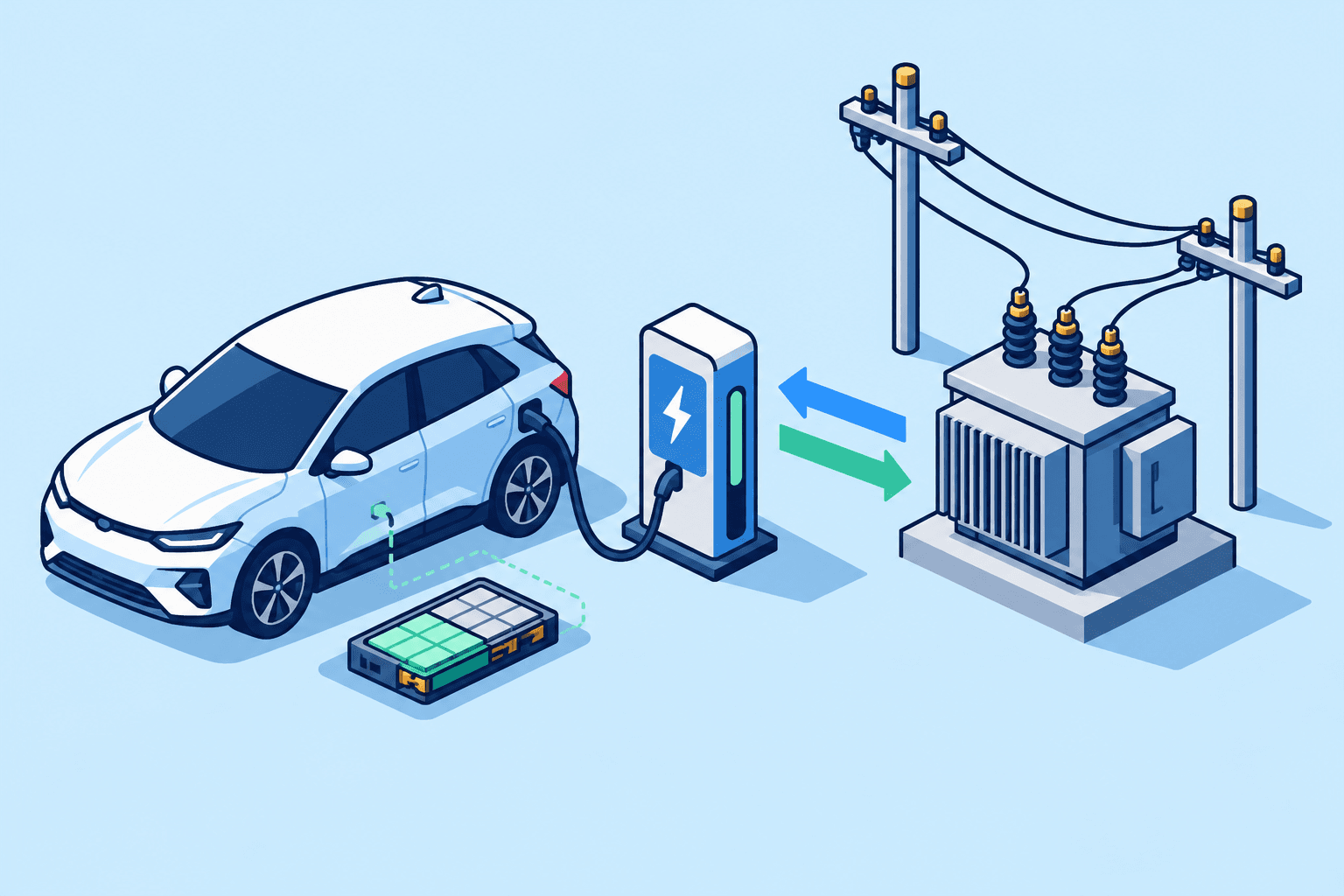
Where the idea began
Early V2G research emerged in the 1990s, as electric-drive vehicles attracted growing interest from the automotive industry and policymakers. In 1997, Willett Kempton and Steven E. Letendre published “Electric vehicles as a new power source for electric utilities” in Transportation Research Part D. The paper examined an opportunity: allowing parked vehicles to supply power to the electricity system through a controlled, bidirectional connection.[2]
The idea drew on the complementary needs of transport and electricity systems. A vehicle carries equipment to power its journeys, but some of that capability sits idle while it is parked. The grid, meanwhile, needs supply to adjust as demand changes. A battery vehicle can make stored electricity available while plugged in; early research also considered the generating capacity of hybrid and fuel-cell vehicles.[2][4] The proposal gave onboard energy equipment an additional role during the hours when the vehicle was not being driven.
The name followed the idea. The research team’s publication index notes that the 1997 paper predates its use of the term “V2G.” By 2001, a report prepared for the California Air Resources Board and the Los Angeles Department of Water and Power explicitly used both Vehicle-to-Grid and V2G in its title and text.[3][4] The 1997 paper is therefore an important starting point for the core concept, with use of the name documented in subsequent work.
Why frequency regulation came first
Once a parked vehicle could connect to the grid, the next question was which services would be worth providing. Battery capacity determines how long a vehicle can supply electricity; what the grid pays for determines the value of that supply. Early studies evaluated different uses separately to identify where participation could make economic sense.[4][5]
In 2005, Kempton and Jasna Tomić identified fast-response, higher-value electricity services as near-term opportunities. Under the equipment and market conditions they studied, sustained output for baseload power was relatively costly. Regulation and reserve services, which respond to changing demand or equipment outages, were a better fit for vehicle capabilities.[5] These were economic findings for the conditions of the time; actual returns depend on market rules, equipment costs and how vehicles are used.
Frequency regulation is one such service. As electricity supply and demand change, the system adjusts power to keep frequency close to its target. Connected vehicles can respond to instructions by changing their charging or discharging power.[1][5] This gave early V2G development a practical direction: identify the response the grid needs, then organize vehicles to deliver it during their available hours.
From research to paid grid services
Vehicle tests connected the research to a working dispatch system. In October 2007, the University of Delaware and its partners used an AC Propulsion eBox to receive signals directly from PJM’s control center and provide frequency regulation. The project’s original report was published in 2008.[6] The test brought electricity export, communications and controlled response together in a real vehicle.
On February 27, 2013, the University of Delaware and NRG’s eV2g project became an official participant in the US PJM regulation market and began providing paid services from an electric vehicle fleet. An official announcement that April noted that the project was still operating with a restricted test fleet.[7] Vehicle response had entered a working market: multiple vehicles were combined into a resource that the grid could call on and pay for.
In 2016, a fleet of 10 electric vehicles and 10 bidirectional chargers began providing commercial V2G services in Frederiksberg, Denmark. The University of Delaware’s contemporary account describes four years of preparation with the Technical University of Denmark and grid operators, including adaptation to local equipment, technical requirements and participation rules.[8] Fleet operations offered a practical setting: vehicles performed their transport duties, then a platform organized grid services while they were parked and connected.
These steps show how V2G moved toward operation. Exporting power was followed by vehicle aggregation, execution of instructions, qualification and settlement. Entering another electricity market required those arrangements to fit local conditions. Later deployment followed this path, turning research systems into equipment and services that could be delivered repeatedly.
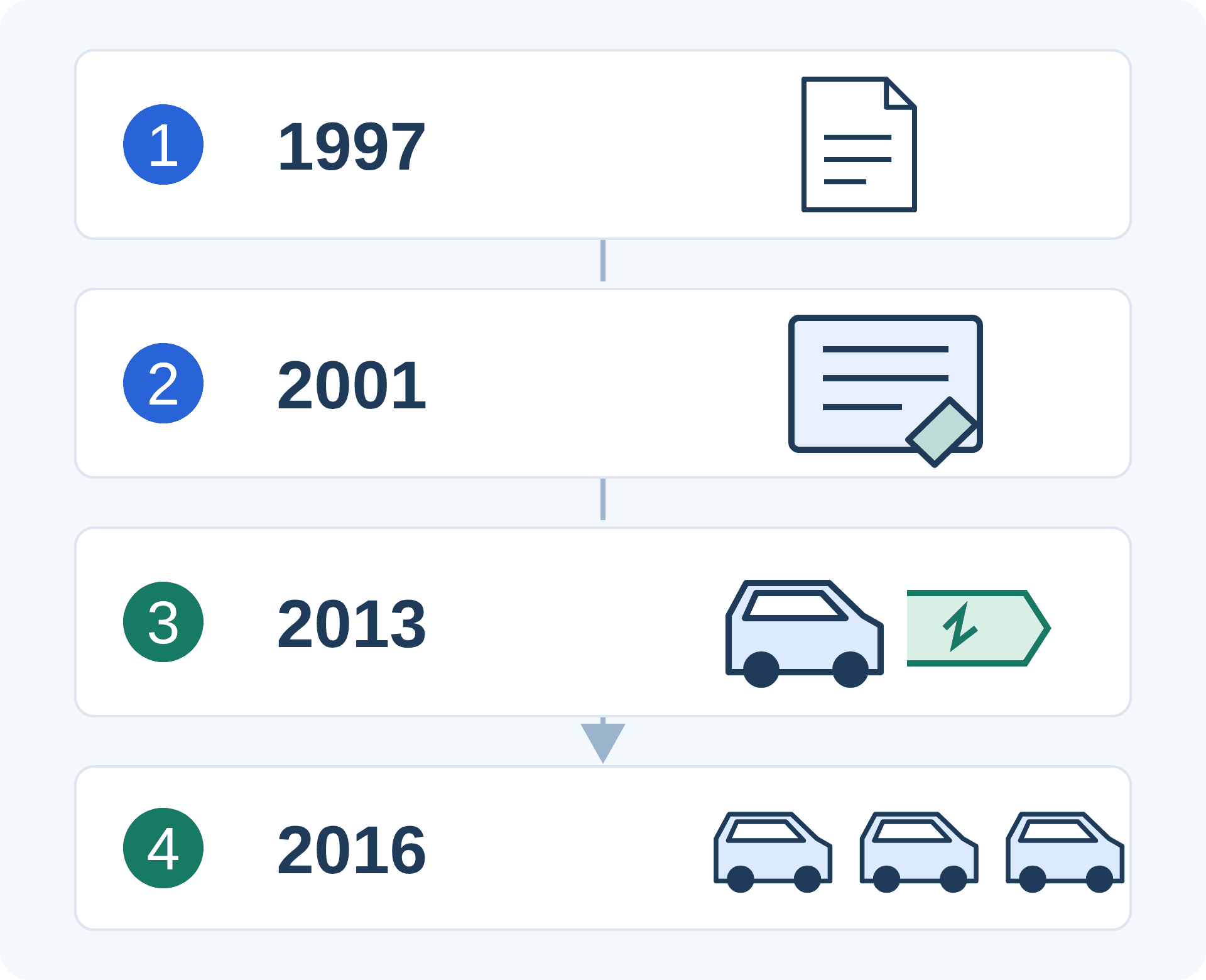
1 · 1997: The core concept is examined
Links parked vehicle capabilities with electricity system needs.[2]
2 · 2001: A research report uses the V2G name
Compares the technical and economic conditions for different electricity services.[4]
3 · 2013: A test fleet enters a paid regulation market
The University of Delaware and NRG project participates in PJM’s market.[7]
4 · 2016: Commercial fleet service begins in Denmark
Ten vehicles and ten bidirectional chargers enter service.[8]
Original illustration based on the cited research and contemporary project records. Milestones are spaced equally in chronological order; spacing does not represent elapsed time. Vehicle symbols indicate a vehicle or fleet, not actual vehicle counts. The selection does not cover every study or demonstration.
Why V2G matters more today
The growth of electric vehicles, wind power and solar generation has broadened the need for this capability. Charging many vehicles at the same time can put pressure on a distribution network. Weather-dependent generation also increases the need for resources that can adjust when and how much electricity they consume or supply. The IEA’s 2026 analysis identifies both changes as part of the context for V2G.[1]
Unidirectional smart charging, often called V1G, can meet some of these needs by reducing charging at busy times and replenishing batteries when supply is more plentiful. V2G adds the ability to export electricity when vehicles have energy available, creating an option for services that require power to flow back to the grid.[1] More EVs therefore bring both charging demand and potential flexibility. How much is available depends on when vehicles connect and what their next journeys require.
How a V2G system works
Using this flexibility starts with a power path that works in both directions. A vehicle connected to compatible bidirectional charging equipment can charge from the grid or return battery energy to it. The vehicle and charging system together provide the power conversion, connection and protection needed to operate within permitted power levels and safety conditions.[1][17]
An energy management system or charging management platform brings transport and grid needs into one operating plan. It takes account of the vehicle’s current battery level, departure time and required energy, alongside connection limits, electricity prices or grid-service requests. It then determines when to charge, when to export and at what power. Feedback from the vehicle and charger allows the plan to be adjusted during operation.[1][18]
For example, a driver might plug in during the evening and specify the next morning’s departure time and required battery level. The system assesses how much energy it can replenish during the remaining connection time, then determines what can be made available for grid services that evening. It schedules exports within that allowance and leaves time to restore the energy needed for the trip. Travel requirements set the boundaries for dispatch, while participation can take place automatically during the parked period. This is an illustrative operating sequence; actual timing depends on the vehicle, grid needs and service agreement.[1][18]
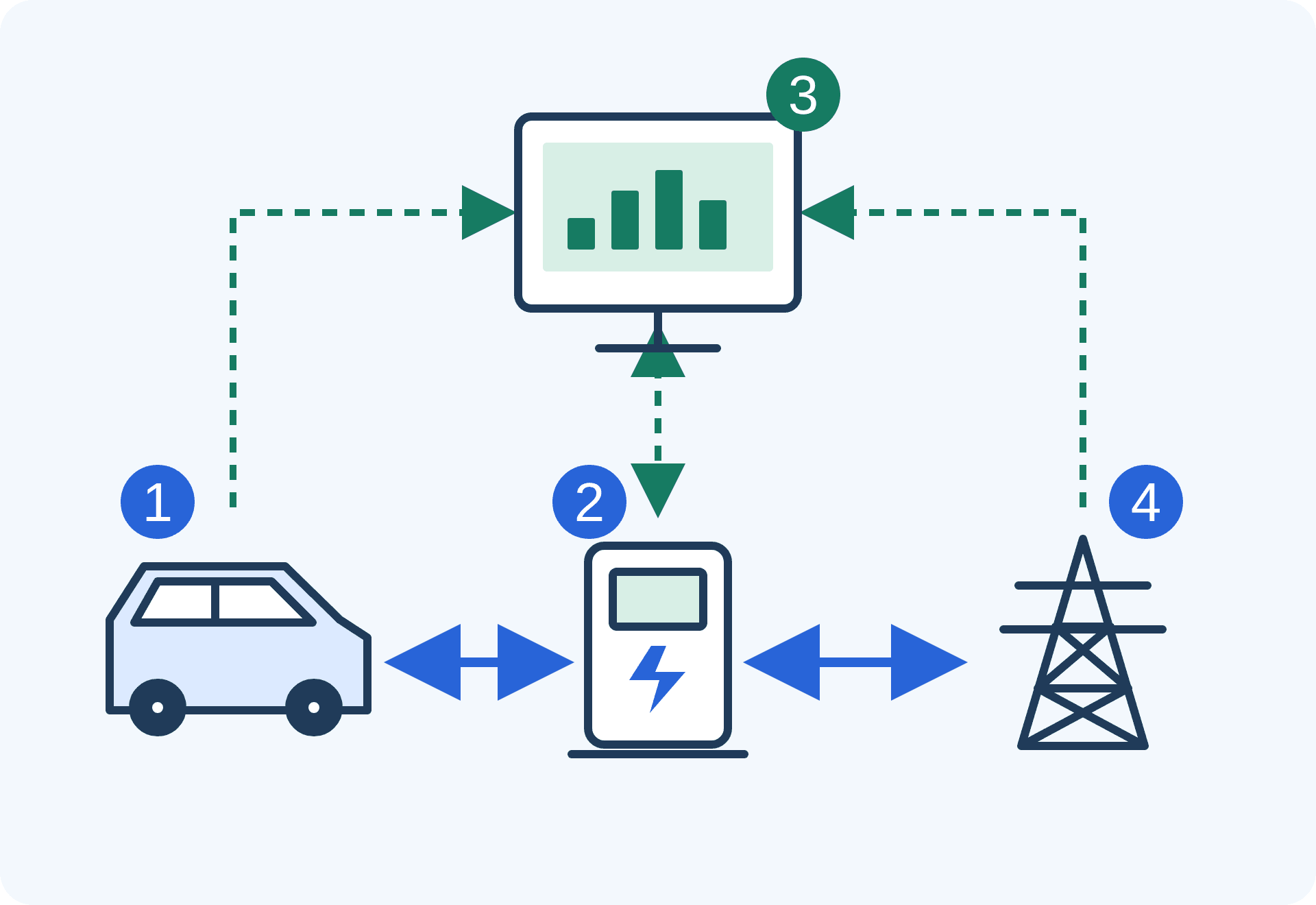
1 · Vehicle
Provides battery storage, with a battery level, charging and discharging capabilities, and travel requirements.
2 · Bidirectional charging equipment
Establishes the charging and discharging path with the vehicle and executes power instructions within allowed limits.
3 · Management system
Coordinates operation using information from both sides. It may run at a home, site or service provider.
4 · Grid and electricity services
The grid provides the electrical connection. Relevant operators or service providers supply constraints, flexibility needs and service signals.
Original functional illustration based on [1][17][18]. Two-way arrows indicate available directions, not simultaneous charging and discharging. Information paths summarize logical relationships; actual communication may be relayed through charging equipment or platforms. Management system deployment and responsibilities vary by project.
When several vehicles participate, an aggregation platform can combine their different availability windows and power capabilities into a service, then allocate requests to vehicles that can respond at that moment.[8][18]
Established communication standards support this coordination. ISO 15118-20 defines communication for bidirectional power transfer between vehicles and charging equipment. OCPP 2.1, released in 2025, explicitly adds bidirectional charging and distributed energy resource control functions between charging stations and their management systems, and supports ISO 15118-20.[9][10] The key communication links from the vehicle through the charger to backend coordination therefore have common rules to follow.
Where deployment stands today
As of October 2026, public records show several forms of progress: commercial offers for private drivers, fleet installations entering operation and programs to expand deployment. Overall coverage remains limited. In its May 2026 assessment, the IEA identified 22 V2G-capable models from evidence including manufacturer declarations and commercial use—less than 1.5% of electric vehicle models. This counts models, rather than vehicles participating on the road, and reflects that assessment rather than a live October total.[1]
In France, Renault power V2G offers available for sign-up in October 2026 combine a compatible vehicle, a bidirectional powerbox, an electricity contract and household connection requirements. Earnings are credited against the electricity bill under the service terms.[11]
In California, PG&E announced in August 2025 that six bidirectional DC chargers had entered operation for Fremont Unified School District. Interconnection under local rules allows the school bus fleet to export electricity to the grid.[12]
In China, four government departments announced the first group of large-scale vehicle-grid interaction pilots in 2025, covering nine cities and 30 projects. The program includes residential communities, charging and battery-swapping stations, and other settings for exploring wider deployment.[13]
The French example shows that some private drivers can already sign up for an integrated service. Its scope is defined by the contract: specified compatible vehicles and chargers, metering and connectivity requirements, and grid-export authorization are part of the arrangement.[11] The US example establishes that a particular fleet installation is operating. China’s list records the planned pilot portfolio; the number of listed projects does not establish how many installations have been completed or how much service has been settled.
China’s broader vehicle-grid interaction program also includes managed charging, so the 30 projects cannot all be counted as V2G export projects. In March 2026, the National Energy Administration’s Jiangsu office visited a verification base in Wuxi to examine construction and operation, including the use of bidirectional charging facilities. It also called for exploration of ancillary services, demand response and incentives for users exporting power.[13][14] Equipment operation and market arrangements are being brought together in specific settings.
The standards and operating services together establish a usable technical path for V2G. Wider model coverage and equipment interoperability still need work. For vehicles and sites that already have the necessary capabilities, interconnection, market access and compensation arrangements directly affect whether participation can continue.[1][10][11][15]
The market conditions for wider adoption
Wider participation requires the value of grid flexibility to reach vehicle owners and operators through electricity tariffs, service payments or contractual returns. Participants need to know who can provide a service, how response is measured, how it is settled and how revenue is shared. The California Energy Commission’s 2026 roadmap identifies complex interconnection and inadequate compensation mechanisms for grid exports as barriers, alongside equipment interoperability and upfront costs.[1][15]
The economics also need to be assessed for the intended use. Bidirectional equipment, installation and operation add costs; charging and discharging incur energy losses; and battery life and usage costs need to be evaluated for the operating pattern.[16] A sustainable arrangement depends on the additional return relative to the existing charging setup and whether it covers the additional costs.
Costs and returns must also connect across participants. Tariffs and contracts should explain who funds equipment and operation, which travel requirements the owner retains control over, and how flexibility revenue is divided. If owners bear most of the investment but receive little compensation, a working system may still attract limited participation. Continued expansion requires a way for those who benefit to contribute to the costs and for those providing flexibility to receive a reasonable return.
V2G has progressed from an idea for using parked vehicles to paid grid services, commercial fleets and offers for private drivers. Bidirectional equipment, management platforms and key communication standards now provide a technical foundation. Scaling up requires interconnection, trading, metering and compensation arrangements to keep pace. Turning available flexibility into sustained returns is central to bringing the existing technology into everyday service.
References
- [1] International Energy Agency (IEA) · Vehicle-to-grid technology · Global EV Outlook 2026 analysis, May 20, 2026; model figures refer to this assessment
- [2] Willett Kempton and Steven E. Letendre · Electric vehicles as a new power source for electric utilities · Transportation Research Part D 2(3), pp. 157–175, 1997
- [3] University of Delaware, Center for Research in Wind · V2G Publications · Research team publication index, checked October 29, 2026; the 1997 entry comments on use of the name
- [4] Willett Kempton, Jasna Tomić, Steven Letendre, Alec Brooks and Timothy Lipman · Vehicle-to-Grid Power: Battery, Hybrid, and Fuel Cell Vehicles as Resources for Distributed Electric Power in California · June 2001, UCD-ITS-RR-01-03; report prepared for CARB and LADWP
- [5] Willett Kempton and Jasna Tomić · Vehicle-to-grid power fundamentals: Calculating capacity and net revenue · Journal of Power Sources 144(1), pp. 268–279, 2005; author’s archived manuscript
- [6] University of Delaware, Pepco Holdings, PJM and project partners · A Test of Vehicle-to-Grid (V2G) for Energy Storage and Frequency Regulation in the PJM System · November 2008; January 2009 clarification revision, pp. 3 and 7; documents the 2007 vehicle test
- [7] State of Delaware · In First, Electric Vehicle-to-Grid Technology Sells Power to PJM Power Grid · April 26, 2013; records market participation from February 27, 2013 and the test-fleet scope at the time
- [8] University of Delaware, UDaily · UD-developed V2G technology launches in Denmark · August 29, 2016; contemporary project account
- [9] ISO · ISO 15118-20:2022 — Road vehicles — Vehicle to grid communication interface — Part 20 · April 2022, first edition; the official catalogue also lists a 2026 amendment
- [10] Open Charge Alliance · OCPP 2.1 is now available! · January 23, 2025
- [11] Renault France · Power V2G — Recharge bidirectionnelle pour véhicule électrique Renault · Live product and contract terms, checked October 29, 2026; evidence for Renault’s own service scope
- [12] PG&E · PG&E and The Mobility House Launch Vehicle-to-Grid Electric School Bus Fleet with Fremont Unified School District · August 11, 2025; commissioning announcement from a project participant
- [13] National Development and Reform Commission and three other departments, China · Notice on the First Group of Large-Scale Vehicle-Grid Interaction Pilots [translated title] · Notice No. 241 of 2025, published April 2, 2025; includes city and project lists; in Chinese
- [14] National Energy Administration, Jiangsu Regulatory Office, China · Jiangsu Energy Regulator Visits Wuxi to Examine Vehicle-Grid Interaction Pilots [translated title] · March 31, 2026; account of site operation and market-mechanism exploration; in Chinese
- [15] California Energy Commission · A roadmap to unlocking the benefits of bidirectional charging · March 2026, filed March 5, 2026; pp. 8–9
- [16] US Department of Energy (DOE) · Vehicles-to-Grid Integration Assessment Report · January 2025, Section II.B, pp. 60–68
- [17] US Department of Energy, Federal Energy Management Program (FEMP) · Bidirectional Charging and Electric Vehicles for Mobile Storage · Web guidance, checked October 29, 2026; bidirectional vehicle–charger operation and grid services
- [18] US Department of Energy, Federal Energy Management Program (FEMP) · Smart Charge Management Implementation for Federal Fleets · Web guidance, checked October 29, 2026; vehicle data, operating objectives, monitoring and coordination